Most marketing strategy workshops are a waste of billable hours.
You gather your senior team in a room, cover a whiteboard in sticky notes, run through a generic SWOT analysis and debate capabilities. By the end of the day, everyone feels productive, yet three months later, your firm is still submitting the same copy-paste RFP responses and relying on the same unpredictable referral channels.
If you lead a professional services firm or commercial construction business, generic marketing workshops fail because they focus on the wrong question: "What do we do?"
To win high-value retainers and secure major commercial tenders, your strategy session must answer the only question your clients care about: "How do you protect us from risk and help us win?"
Here is how to structure a client-centric, outcome-driven marketing strategy workshop that aligns your decision-makers, eliminates tender risks and builds a predictable growth engine.
1. Shift from Capability Framing to Client Risk Diagnosis
The biggest trap for law practices, accounting firms, and commercial contractors is leading with technical features. Listing your accreditations, headcount, or software stack doesn't win work, it simply grants you permission to bid.
Before your workshop, mandate that all attendees look at your market through the lens of client risk protection.
The Workshop Exercise: "The Client Risk Audit"
Instead of asking "What are our core strengths?", ask your team:
- What expensive operational or financial risks are keeping our prospective GMs and developers awake at night?
- Where do traditional competitors fail these clients during project execution or dispute resolution?
- How does our delivery model specifically eliminate those client risks?
Outcome: You stop positioning your firm as a service vendor and start positioning it as an indispensable risk-mitigation partner.
2. Ditch Generic SWOTs for "Tender & RFP Post-Mortems"
A standard SWOT analysis yields superficial insights. Commercial construction firms and professional service practices grow by winning competitive proposals, not by filling out four quadrant boxes.
Replace generic brainstorming with a rigorous audit of your last 12 months of bids and client proposals.
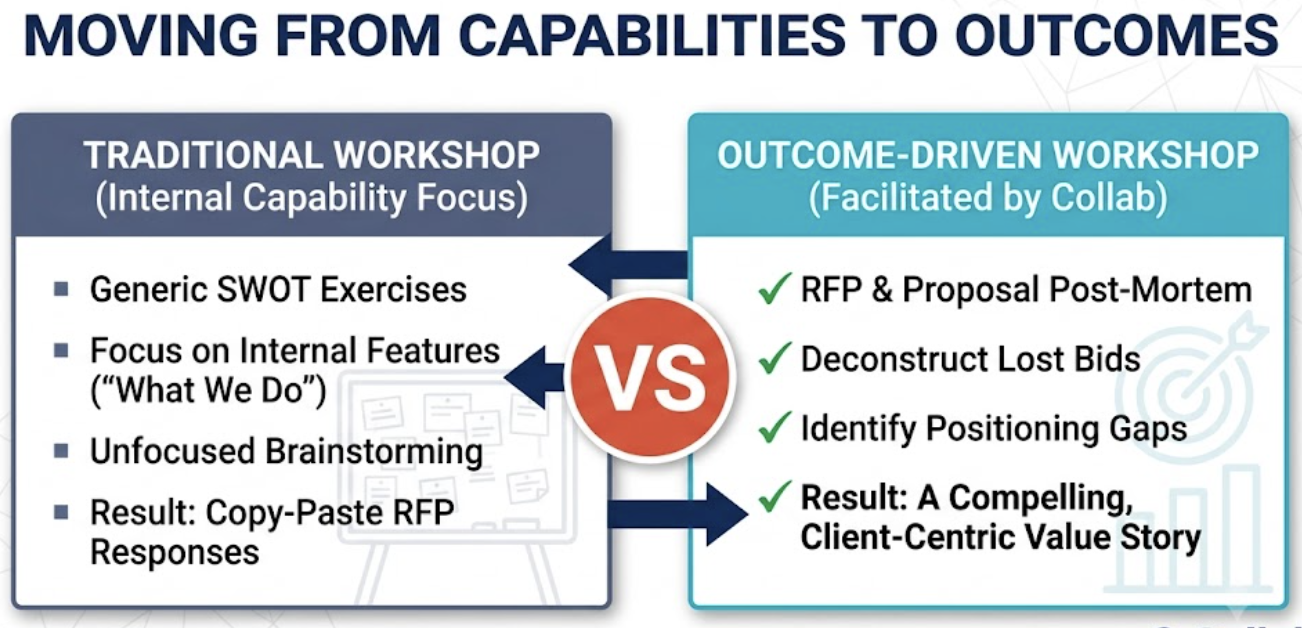
The Workshop Exercise: Deconstructing Lost Bids
Bring three won tenders and three lost tenders into the room. Analyse the qualitative feedback:
- Did we lose on price, or did we fail to prove business transformation?
- Did our pitch focus on our track record, or their business case?
- Where did our positioning fail to differentiate us from the other short-listed firms?
Understanding why you lost an RFP reveals the exact message gaps your marketing strategy must solve.
3. Map the True Stakeholder Ecosystem
In commercial construction and professional services, buying decisions are rarely made by a single person. A commercial build involves procurement heads, project managers and CFOs. A legal or accounting retainer involves partners, GMs and boards.
A successful strategy workshop must map every decision-maker who can block or approve your proposal.
Key Stakeholder Questions to Answer:
- The Economic Buyer (CFO/GM): What return on investment or risk reduction do they need to see to justify our fee?
- The Technical Evaluator (Project Director/Legal Counsel): What technical proof do they require to feel safe recommending us?
- The End User: How does our service make their day-to-day operations smoother?
Aligning your messaging across all three tiers ensures your tender responses pass both the technical audit and the executive sign-off.
4. Set Strategic Constraints to Force Creative Breakthroughs
Blue-sky strategy sessions lead to lazy, unfeasible ideas. Setting artificial constraints forces your partners and senior executives to think critically about market positioning.
3 High-Impact Constraint Scenarios to Challenge Your Team:
Scenario A: The 50% Budget Cut
"If our legal and accounting budget was reduced by half, which strategy would we keep to win the RFP?"
Scenario B: The Incumbent Advantage
"Imagine our direct competitor slashes their fees by 20% on an upcoming tender. What value story do we tell that makes price irrelevant to the client?"
Scenario C: The Disruption Defense
"If a prospective client deleted our entire 'About Us' capability document, how would we prove our value using only client outcomes and case metrics?"
5. Eliminate "Groupthink" with Fast-Five Silent Voting
In firms led by strong managing partners, directors, or senior founders, strategy workshops often degenerate into an echo chamber where the highest-paid person's opinion wins.
To extract authentic insights from your technical leads, business development managers and subject matter experts, implement silent ideation.
How to Run Silent Ideation:
- Pose a strategic question (e.g., "What is the single biggest operational barrier preventing us from doubling our win rate on tier-1 tenders?").
- Give everyone 5 minutes of total silence to write down their top 2 responses on index notes or a digital canvas (like Miro or Mural).
- Collect and group the responses anonymously before opening the floor for debate.
This protects conflict-averse team members and ensures the best commercial ideas surface regardless of hierarchy.
6. Audit Your Messaging: From "What We Do" to "How We Win"
The ultimate output of your strategy workshop should be a clear, outcome-driven messaging matrix. Take your current marketing materials, website copy and tender templates and put them through the Client Transformation Test.
|
Feature-Led Copy (What We Do) |
Outcome-Driven Copy (How You Win) |
|
"We provide commercial dispute resolution and litigation services." |
"We protect your balance sheet and resolve commercial contract disputes before they stall project delivery." |
|
"Tier-3 commercial construction and civil engineering contractors." |
"We de-risk complex commercial builds, delivering projects on schedule without costly variations." |
|
"Full-service accounting, tax advisory and audit firm." |
"We restructure financial operations to preserve capital, improve cash flow, and prepare your business for scalable expansion." |
7. Turn Workshop Insights into an Executable 90-Day Roadmap
A marketing strategy workshop without clear execution is just expensive corporate entertainment. Conclude your session by assigning clear accountability and realistic timelines.
- Assign Single-Point Ownership: Every strategic action item must have one named owner, not a committee.
- Define Key Deliverables: Translate high-level strategy into immediate assets (e.g., a revamped RFP response framework, high-value client case studies, or a targeted Account-Based Marketing campaign).
- Establish a 90-Day Sprint: Group action items into 30, 60, and 90-day execution cycles to maintain momentum.
Stop Guessing Your Growth Strategy
Facilitating an internal strategy workshop while trying to contribute as a business leader is tough. Objectivity gets lost, internal dynamics take over, and teams default to familiar, low-impact ideas.
At Collab Agency, we facilitate intensive Marketing Strategy Workshops designed specifically for professional services firms and commercial construction businesses.
We bring veteran CMO perspective to your table challenging assumptions, diagnosing market positioning and translating your firm's technical expertise into a compelling, tender-winning narrative.
Ready to transform your marketing into a high-converting growth engine?
Book a Facilitated Strategy Session with Collab →
Explore how our Fractional CMO and Workshop services help your business win higher-value clients and secure key tenders.